
The CLEF Laboratory has launched translational studies that bridge our basic science in animal models to the human condition. WAVE-AD represents our commitment to making an impact on human health and understanding.
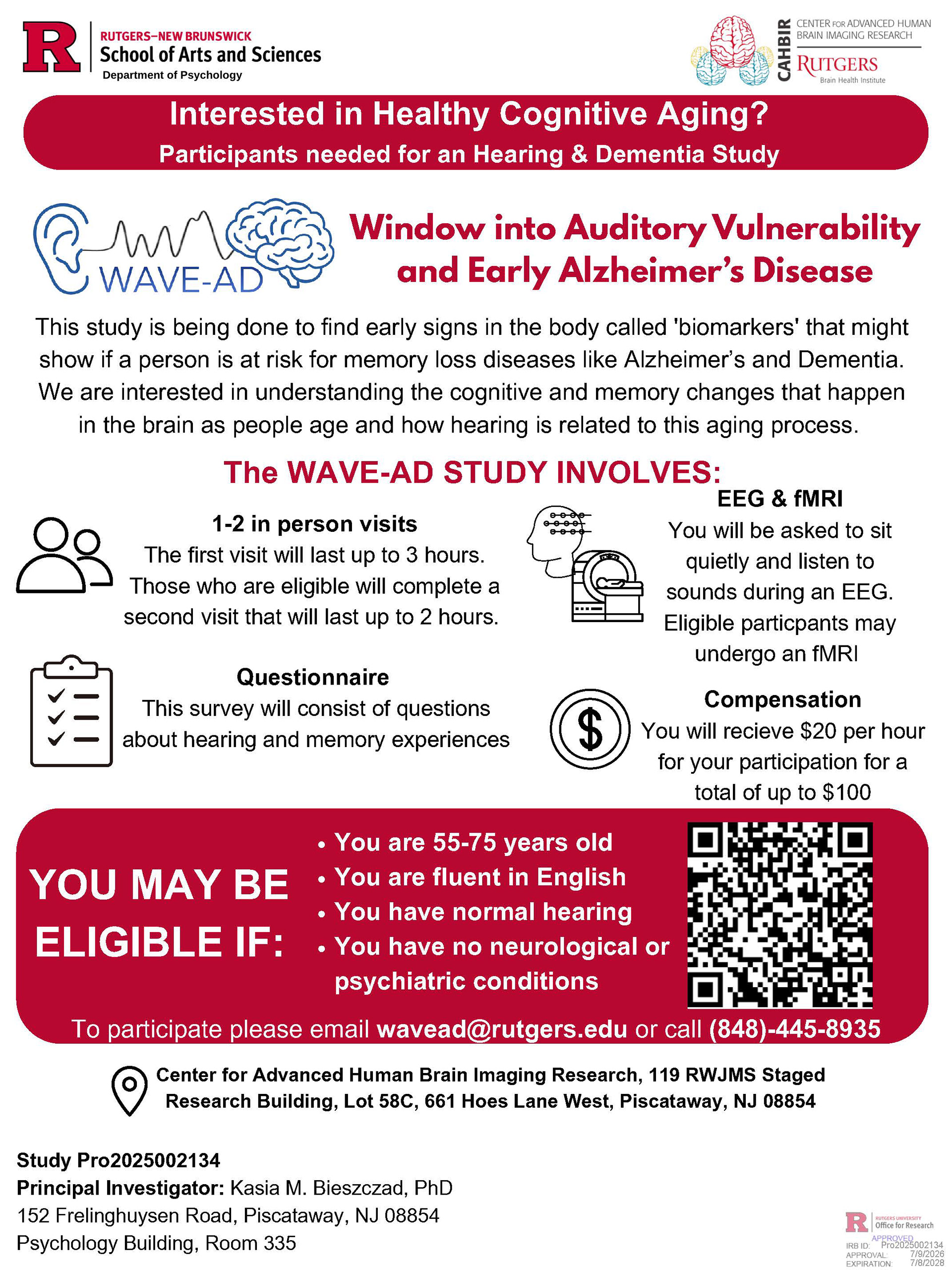
Window into Auditory Vulnerability in Early Alzheimer’s Disease (WAVE-AD): The Auditory Brainstem Response As a Very Early Biomarker in AD Risk in Rats and Humans
Hearing loss is the largest modifiable mid-life risk factor for Alzheimer’s disease and related dementias (AD/ADRD), yet neurophysiological mechanisms bridging auditory dysfunction and early AD pathophysiology remain poorly understood. We recently reported a very early neurophysiological biomarker of AD risk through the non-invasive, rapidly acquired and clinically translatable auditory brainstem response (ABR; Aydin et al. 2026 PMID:42106438). Metrics derived from multidimensional parametric feature extraction on the distribution statistics of continuous neurophysiological time series data from ABRs (Torres et al. 2023 PMID: 36798622) significantly separate neurodegenerative risk in AD knock-in rats from healthy controls in a sex- and age-dependent manner. The findings suggest that deviations in sound-evoked neural activity provide a window into synaptic-level processes that are disrupted in early stages of neurodegenerative disease. We aim to bridge these findings for application in human subjects. Identically derived metrics from tone-evoked ABRs in humans will be presented to determine if ABRs likewise correlate with mild cognitive impairment (MCI) vs. healthy controls. Data analyzed alongside resting state EEG and fMRI activity will be used to gain a mechanistic understanding of why ABR metrics may coincide. We hypothesize that the delicate balance between excitatory and inhibitory synaptic processes are irregular very early in at-risk humans (Mitsuto et al, 2025, PMID: 41279490), and recapitulated in animal models of the human disease. If so, the ABR may provide a cost-effective, accessible, and non-invasive physiological proxy for broad synaptic dysfunction relevant to early screening for AD/ADRD risk. As a rapidly acquired, pre-attentive, and inexpensive brain signal to access in both animal and human models, the sound-evoked ABR represents a highly promising candidate for future basic science and clinical use.
Please visit our study website for more information!